- Sep 13, 2024
We Need To Talk | How To Sharpen Your Discovery Skills For Customer Success Professionals
- Diana De Jesus
I was a few months into my first job as a CSM when I realized something.
I sucked at discovery skills.
I came from customer support land, where that wasn’t really a thing.
Sure, we’d ask additional questions to get to the root cause, but it was within a controlled environment.
In Customer Success, it felt more like the Wild West.
I didn’t know what my end goal was with my questions.
I didn’t know if I should keep digging or accept the client’s initial answer.
And to make things worse, I was so caught up with what I was going to say next that I couldn’t really listen to their response.
I knew I needed to address this challenge if I wanted to continue pursuing a career in CS.
So I went looking for any resources I could find, and of course, the majority of them were… fluff.
But when I found the right resource(s), I struck gold 🥇
Gain Grow Retain did – not one – but two podcast episodes featuring Bob London, an expert in strategic conversations.
In the episodes, he shared the exact questions to ask (plus why) and the core skills CSMs would need to improve to become more… strategic.
I immediately started implementing his advice and seeing the impact – my clients were opening up to me. I wasn’t feeling overwhelmed. I was moving that needle we keep talking about.
The most impactful skill a CSM can develop is the ability to have strategic conversations.
Think about it!
As a CSM, if you didn’t uncover the customer's needs, what are you actually working towards?
How can you measure the true impact of your service on the customer’s business performance without deep insights into their strategic objectives and metrics?
How are you identifying upsell/cross-sell opportunities if you’re not discussing the additional needs the client might have?
How are you building a strong strategic relationship if your conversations are surface-level or only about your feature/product?
It really impacts everything we do as CSMs, which is why we're writing this post on!
#UpSkill | Strategic Conversations
Step 1: Pick the right format
We’re looking to have open-ended conversations!
The type of questions you ask can elicit conversations… or not.
Stick to asking questions that start with “what,” “who,” “why,” “how,” and “Can you tell me about…”
Scale back on the “would you,” “did you,” and “are you” questions.
Step 2: Being nosy is your new motto
At Catalyst, we practiced the 5 whys mindset with our clients when conducting discovery. Here’s what it looked like:
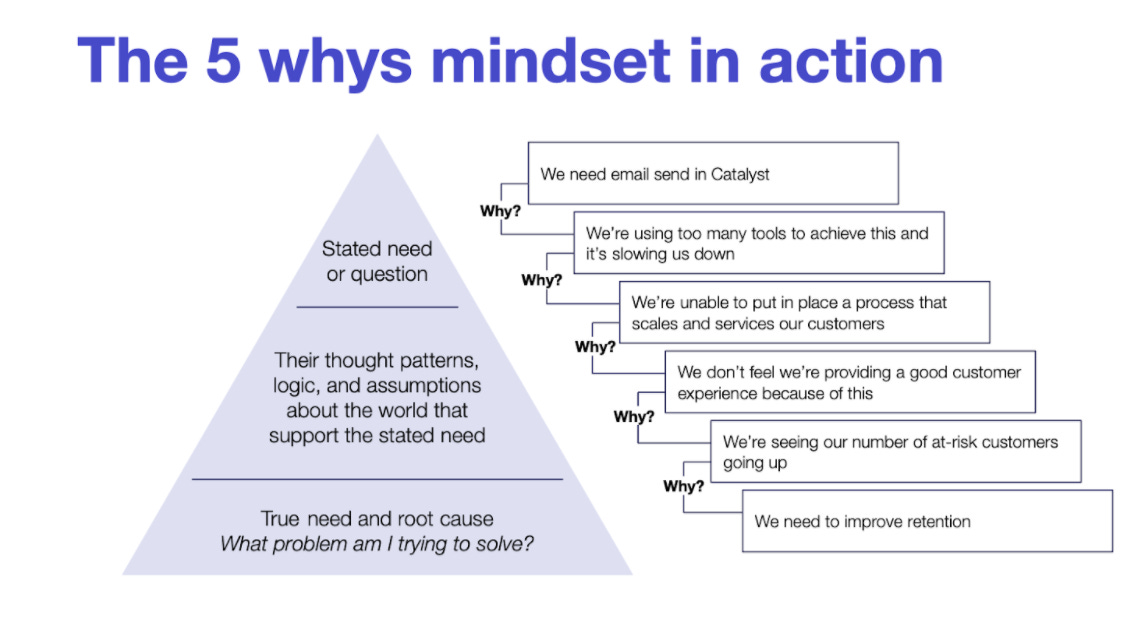
But sometimes, asking “why” five times in a row can get a little… tiring. That’s when you need to tap into probing questions like these:

Step 3: Shut up (respectfully)
If you’re anything like me, you’re likely a rambler.
Your customers are never going to share the golden information you’re after if you’re talking 90% of the call.
Once you drop your incredibly strategic question, it’s time to take a step back and zip it (respectfully).
Step 4: Listen up!
There’s hearing what your customers are saying, and then there’s active listening.
Here’s a checklist to help you tap into your active listening skills:
Listen up: try to silence your thoughts.
Reflect on what was said: take a moment to think about what was shared.
Summarize what you heard: repeat back what you heard and welcome clarification.
Acknowledge, clarify, and move forward.
How to implement this upskill tactic tomorrow
Review your upcoming client-facing calls and identify one with whom you want to engage in a strategic conversation.
Prepare for the call by pre-writing the strategic question(s) you’ll be asking during the call. This doesn’t have to be on a slide, but if you feel more comfortable, that’s cool too!
Familiarize yourself with the probing questions from step 2 so you’re ready to reply.
Do a mini retro – how did it go? What can you improve?
Can it be measured?
Short term
You can track the number of strategic questions you’re asking per call.
You can measure your talk time with tools like Gong.
Stakeholder relationship sentiment score.
Long term
You should always be tracking your CSM stats (keep it updated monthly).
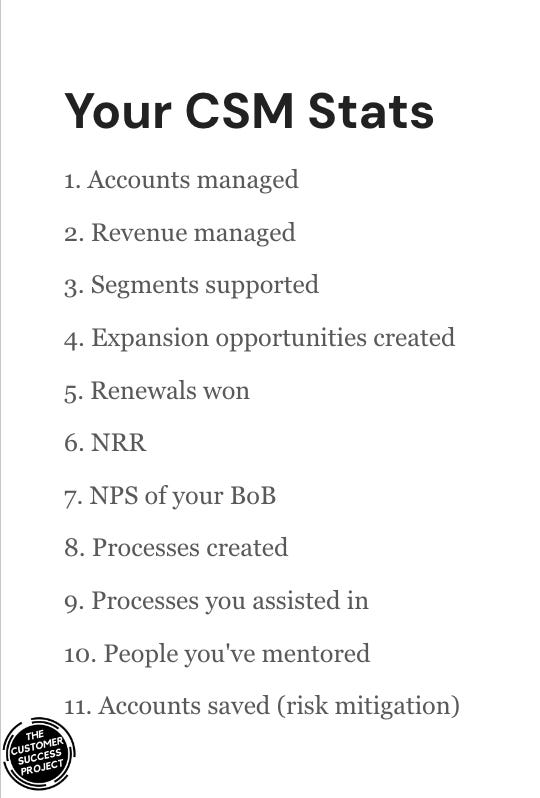
Keep an eye on the following activities:
Success plan completion rate
New revenue opportunities unlocked
# of stakeholders per account
Having more strategic conversations will take time. Practice patience 🙂
Looking for help with your discovery skills in expansion and renewal conversations? We have a bite-size course just for you!
Newsletter
Weekly Newsletter With Actionable Insights
Gain the skills, knowledge, and confidence to succeed in Customer Success & Account Management: 0% theories, 100% actionable insights.