- Aug 30, 2024
What To Do When The Feature Request Never Seem To End | For Customer Success & Account Management Professionals
- Diana
A few weeks back, Stino had me reliving one of those “that-moment-shaped-me-as-a-CSM” stories on his podcast.
Here’s the story…
Early on in my CSM career, I managed an account that was a very big deal (in every sense of the word).
✅High revenue
✅Global company
✅Really good logo
On this account, I worked with a few departments separately to help them achieve their goals, but one team was a bit challenging to work with.
Every week, I showed up to our call to talk about… Features.
“Ohhh, I found a feature I want to talk to you about that looks cool!”
“I have a new feature request... We really need an integration with…”
“Let me open up my sheet of feature requests to show you…”
And when it wasn’t about features, it was about something that was happening with a question or issue they sent over to the support team.
I was going around in circles with them, and the lack of movement toward their goals started to worry me.
Of course, I had a looming question many CSMs have hanging over their heads:
“At this rate, will we have done enough to justify them renewing?”
The thought of losing our precious account made me sick to my stomach, so I knew I had to do something about it…
I hopped on my Google search bar and typed in “how to stop clients from talking about features.” That was a little too specific, but after a few pages of results, I ended up on a success plan thread from the Gain Grow Retain community.
In that thread, someone was talking about moving client conversations from tactical/reactive to proactive/goal-focused. They shared that something called“success plans” was the key to making it happen.
My eyes shined bright (like a diamond) because… yeah! That’s exactly what I needed.
I went down the success plan rabbit hole, which led me to build a quick base for our plan.
On the next call, I was determined to hit the reset button with the team.
Although my voice might’ve cracked and I felt a little mean (I wasn’t; I just wasn’t people-pleasing), I got through that session and left feeling closer to the proactive promised land.
When we talk about being stuck in firefighting mode, we need to add feature requests to the top of the list of reasons why we’re stuck there.
Why? It’s more than just a brief interaction about the feature; it’s a series of action items and status updates that deprive CS professionals of the impactful work they should be doing.
Here’s how the feature request flow usually works:
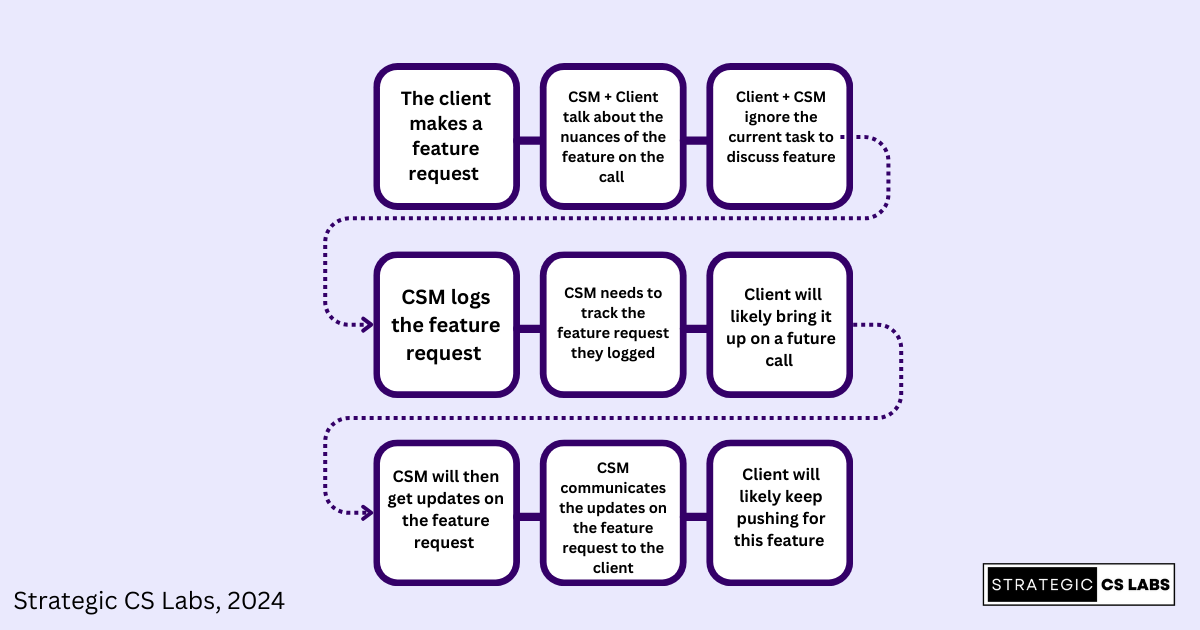
And that’s just for one feature request!
So, how do we get out of this? Well, you’re not doing a CS role if you don’t get at least a feature request or two. That’s impossible.
The goal is to reduce the level of priority these conversations have on our calls and transition the conversation to be centered around the steps needed to achieve the client's objectives.
Easier said than done, so let’s talk about the how below.
How To Move Clients Away From Just Talking About Feature Requests
Step 1: Get on the same page
Here, you’re working on building a game plan with them, the customer.
That game plan includes their goals, the strategies that need to be implemented to achieve those goals, timelines, and owners.
Basically, a success plan.
This success plan should be mutually agreed upon.
By whom? Not just by you and your main point of contact but by you and the decision-makers on your client's side.
The last thing you need is to work towards someone’s personal goals instead of the wider team’s goals.
Having a success plan documented gives you the support you’ll need during those moments when feature talk starts taking over.
Step 2: Identify your feature requester
Next, we want to identify the person who is our feature requester.
Which persona do they fall under? Try to identify them below:
Buyer - responsible for budgeting/buying the product (they care about ROI)
Decider - responsible for deciding if they stick with the product (they care about strategy)
User - responsible for implementing and/or using the product (they care about usability)
Caveat: sometimes they can be more than one persona
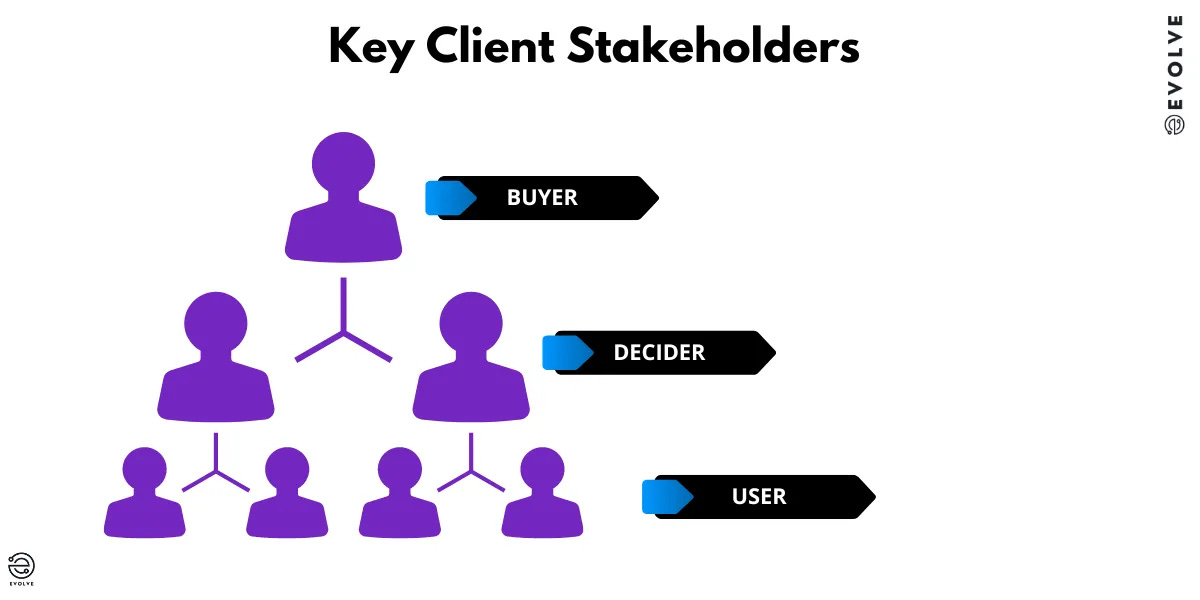
Something tells me the person making these requests isn’t your Buyer. It’s likely a User or Decider/User hybrid.
Knowing this can help us understand how to best navigate this conversation.
If we’re working with a User, talking about “strategy” is totally going to miss the mark. These folks are rooted in day-to-day operations, usability, feedback, and technicalities.
That means we need to translate our strategic goals into actionable, bite-sized tasks that will actually resonate with them.
Step 3: Include them in the game plan
Here’s how you can create those bite-sized tasks that lead towards achieving the strategic goals for them.
First, we add another column to our success plans, which double-clicks into the strategies and provides more detail. This becomes our project plan, which we can work through with our point of contact (who may be a User persona).
Now comes the part where you need to connect the dots for them.
Clearly state that the projects you’ll be working on together will directly impact the wider company in achieving its goal.
Praise them and help them visualize how their accomplishments relate to the company's direct goal.
EXTRA bonus points for shouting them out on business reviews and/or other communication to executive stakeholders on the account.
You’re positioning this as a value-add to them, and you’re making them look really good.
You’re not just making an impact for their company – you’re impacting a person’s career, and that’s going above and beyond!
Second, we substitute our slides (or any other visual aid) for this plan.
A very common issue with success plans is that we pour our hearts and souls into creating them, and then… we might as well archive them because they never appear again in the partnership.
We’re not going to let that happen!
During our sessions, we’ll put these plans front and center to remind everyone of the agreed-upon tasks. This will help deter clients from getting sidetracked on these calls.
Third, we take control of the agenda. I’m contradicting myself here about making agendas more fluid, but that’s for when we want to engage in discovery-driven conversations.
Back to taking control – set the tone for how the calls will go with a clear agenda. Maybe you want to:
Revisit the previous talking points and provide/gather updates
Open the floor for any questions/updates from their end
Dive into the project plan (aka, the success plan but more specific to their tasks that are associated with the strategies that will lead to the wider goals).
Recap and end it with the next steps
Step 4: Handling the feature requests conversations on the call
Let’s be honest: features WILL still get requested on your calls – even with your fancy project plan laid out.
So here’s what you can do:
Let them share what they have to share!
We can’t just cut them off because we’re on a mission to eradicate reduce feature requests/reactive conversations.
Hear them out and decide if the request they’re making falls in or outside of the project plan.
If it falls in, it can directly relate to one of the projects/tasks in the plan, and we can entertain the conversation and take their feedback on board.
If it falls out, we can tell them it’s a good idea, but it falls outside the scope of the project plan, and we can circle back to it down the road.
Here are some actual talk tracks we use in Strategic CS Labs to pivot conversations:
Connects feature to specific goals
"That's an interesting suggestion! Let's see how it connects to the goals we outlined in our success plan. How do you think this feature could help us achieve goal X?"
Frames feature request in the context of current priorities
"Great point about Feature Y. Within our current project plan, we're focusing on achieving Z through Tasks A and B. Perhaps Feature Y could be something we explore after achieving Z?"
Redirects focus to existing projects
"I understand the desire for Feature X. To ensure we're aligned, let's revisit our success plan and see if there's an existing project that this feature could contribute to."
Acknowledges request, redirects to future roadmap discussions
"Thanks for sharing your thoughts on Feature Y. While it's not directly on the roadmap for this project, let's capture this feedback for future discussions on our product roadmap."
Broadens conversation to strategic goals
"Interesting! Feature X sounds like it could potentially impact Goal Y. Let's take a step back and discuss how this feature aligns with our overall strategic objectives."
I’ll leave you with a few thoughts to help you on your journey to becoming less… stuck.
The longer you’ve been in this state with a client, the harder it will be to break free from the hold these conversations have had on your partnership. Start small and be patient!
You don’t always have to say “yes”. Your power as a CS professional is to push back when it’s in the best interest of your client. I know it’s a little scary, but the benefits include your peace of mind, the success of your client, and the success of your company.
Can It Be Measured?
Yup! And this one is an easy one:
Feature Requests Logged: This is kinda like our starting point. Track how many feature requests get logged before you put this new strategy in place. Then, track it again after, say, a few months. Fewer requests? That means you're probably on the right track, focusing more on those projects in the success plan.
-
Task Completion Rate: This is all about getting things done on time (or even early!). Track what percentage of tasks in your project plan get finished when they're supposed to. The higher that number goes, the better. It shows you're working together more effectively. (Dig a little deeper here, too: How long are tasks taking? Are some things consistently stalling? Maybe that means some folks need a little extra training, or the plan itself needs a bit more clarity.)
Time to Completion of Tasks/Success Plan: This one looks at the big picture: how long does it take to achieve those goals you mapped out in the success plan? Track the total time it takes to finish all the tasks in a project compared to the original timeline. If you're wrapping things up sooner, that means you're on a smooth, efficient track.
Newsletter
Weekly Newsletter With Actionable Insights
Gain the skills, knowledge, and confidence to succeed in Customer Success & Account Management: 0% theories, 100% actionable insights.