- Aug 30, 2024
How Do We Actually "Build Relationships" in Client Management Anyway?
- Diana
“Drive value”
“Deliver outcomes”
“Become a trusted advisor”
Oh, and my favorite:
“Build relationships”
These are just some of the many directives we hear in customer success.
I don’t disagree with any of them. But when I hear them, I’m always left with a burning question…
How?

The how is the very reason why I created this newsletter in the first place. And so today, I want to tackle one of these popular principles.
I think it’s the most overused yet misunderstood one of them all. It somehow seeps into the rest, which can make or break our entire CS game.
It’s none other than:
Building Relationships!
Now, before you close this window, I want you to truly ask yourself if you know know what “building relationships” is all about.
Because this one here feels like a piece of cake, it’s easy to overestimate.
Everyone and their mother knows how to “build relationships.”
But underneath its unassuming facade, it’s more intricate (and impactful) than we give it credit for.
So, I invite you to put “building relationships” under a microscope with me in this post. Let’s get started.
How Does Building Relationships Actually Work In Customer Success
What Does It Mean?
We’re taking it from the top.
What exactly does “building relationships” mean in the context of customer success? Let’s tackle a non-fluffy definition together:
Building relationships in customer success isn’t a one-time event.
You don’t just show up to that first client interaction, and bam! Relationship built!
It extends beyond the “Hey, how was your weekend?” chat – we’re here to cultivate a long-term partnership where trust and understanding flow freely.
Your ultimate goal is to become someone your client feels comfortable confiding in, someone they trust enough to share critical information about their business (and personal) goals and challenges.
Having access to this level of transparency is your key to their success! The more they tell you, the better you can help them get the most out of your product.

Beyond them confiding in you, you also want them to trust you enough so that they follow your guidance. To do that, you’ll need to consistently show them that 1. You know your stuff, and 2. You’re committed to their success.
This kind of trust and open communication are the foundations of a strong customer relationship—or any relationship, for that matter.
Let’s take things one step further – here are four guiding principles we can add to our definition:
Invest in their success - The stakeholder and the business. Know who they are and what they care about. You want them to win and celebrate them along the way. #oneteam
Genuine communication - It's a two-way street! Actively listen to their concerns, ask insightful questions, and provide clear and transparent communication.
Be proactive - Have you ever had a friend who never calls you? You’re the one who always calls them? Please don't wait for them to reach out first (usually with an issue). Regularly touch base, anticipate their needs, and offer solutions before problems escalate.
Generate trust - Be reliable, honest, and follow through on your commitments. This builds trust, which is the foundation of any strong relationship in and outside of CS.
Now, let’s take a closer look at these principles individually.
1. Invest in Their Success:
Know Your Stuff: Get to know your client's business, goals, and challenges. How? Do your research on the company (I love starting with Crunchbase), understand their industry & competitive landscape, and ask lots of questions. This is the first pillar of The RISE System and what I harp on the most in Strategic CS Labs.
Celebrate Wins (Big and Small): A quick "congrats" on a successful campaign shows you're there for them. You don’t have to be over the top (like sending a bottle of champagne on their 2-month-versary of being your customer).
Be Their Knowledge Bank: Share industry trends and resources to help them stay ahead of the curve on how their business may be impacted (and how you can help).
2. Genuine Communication
Listen Up: Yes, of course, we’ve got so much to share. We want to show them how to solve their problems and how we can help them. But we need to start by hearing their concerns and goals first!
Ask Smart Questions: Don't settle for yes or no answers. These are surface-level replies. The real information you’re looking for is just a few “why?” and “tell me more about…” questions away.
Be Clear and Honest: Explain things simply, no jargon (if possible). Be upfront, even if it's not what they want to hear (more on that below).
3. Be Proactive
Regular Check-Ins: Schedule calls, emails, or virtual coffee chats to stay connected. You don’t have to wait until things are burning, or you need to get them on a call to talk to them. And don’t forget; each stakeholder persona will need you to “check in” differently.
Stay On Top of Data: Look at your client's data and set up a Google Alert to follow their company news so you’re up to date. These insights will give you the excuse to fire off that email.
Have an Eye For Solutions: Always look for ways to add value. Offer training materials, suggest product hacks, or connect with successful customers. QBRs aren’t the only place to “add value.”
4. Generate Trust
Keep Your Promises: Be reliable. Whatever you say you’ll do, be sure to follow through. Sometimes, this is easier said than done—that’s why I dedicated an entire post to taking action (because talk is cheap).
Don’t Be A Yes Person: While it may feel like the easy way out is to say “yes” to whatever our clients want, we’re here to guide them, which requires a “no” from time to time. Don’t be afraid to push back or shift your direction if it’s in your client's best interest and the relationship.
Be Their Champion: Advocate for your client within your company. Help them navigate internal processes and make sure they're heard. But also, surprise them with tools and resources to help them win in their jobs, too!
We’re ready to see some of this in action!
Examples of Building Relationships vs. Non-Building Relationships in CS
Now, let’s look at some direct examples of when we think we’re building relationships with our clients… but we’re not.
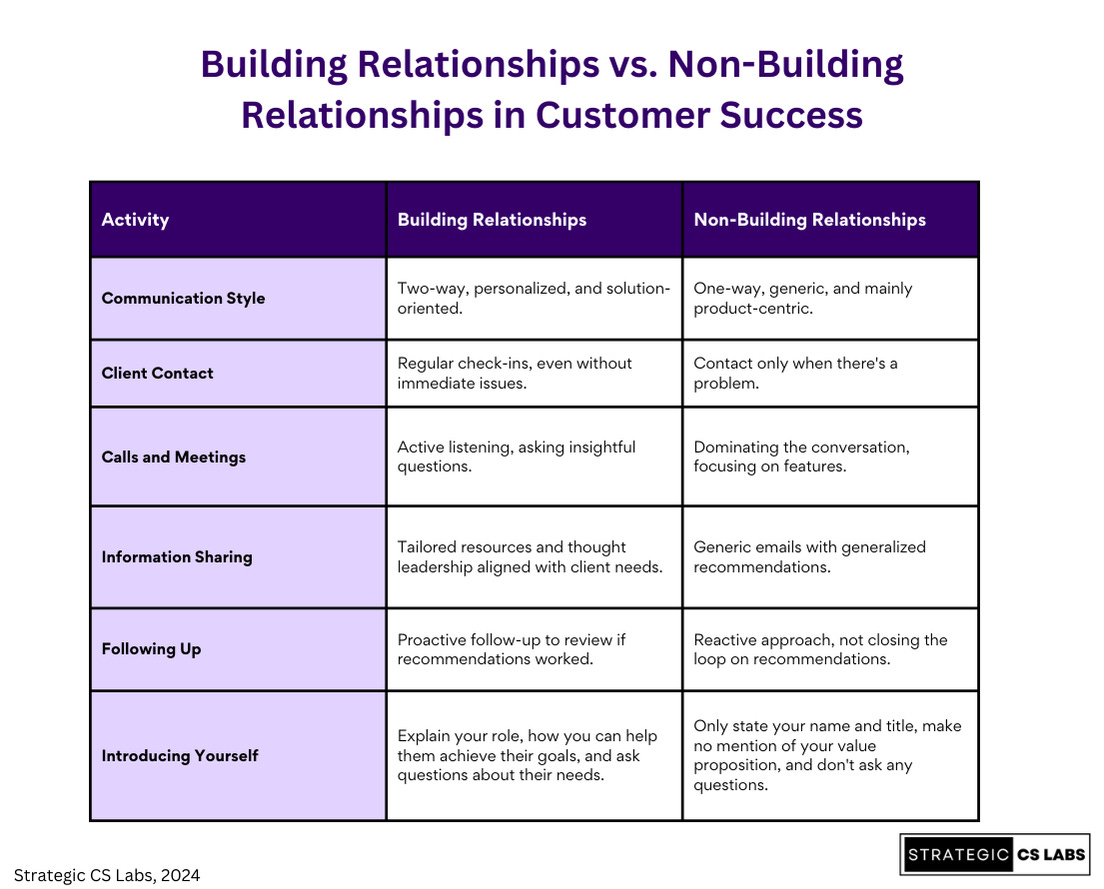
In our day-to-day world, those examples can manifest into scenarios like the following:
Scenario 1: Transactional vs. Proactive
What Building Relationships Isn't (Transactional):
John, a CSM, believes he’s built a great relationship with his client, Sarah, who works at a marketing agency! They chat regularly (during their monthly check-in calls), and he even sent her a birthday card (not bad!). On their calls, Sarah shared with John that she’s been struggling with lead gen, but since John’s primary focus is to push for an upgrade, he sweeps her concerns under the rug and instead does a product demo of the features that are part of the next plan up.
What Building Relationships Is (Proactive):
Mike, another CSM, also has a good relationship with Sarah. However, Mike takes a more proactive approach. He regularly reviews Sarah's account data and notices a dip in lead generation. Mike reaches out to Sarah before it becomes a major issue and asks about her lead gen strategies. They discuss potential roadblocks, and Mike suggests relevant resources within the product and connects Sarah with another customer who mastered lead gen using the same tool.
Scenario 2: One-sided vs. Shared Success
What Building Relationships Isn't (One-sided):
Meagan, a CSM, emails her clients when she needs to book a call, such as a QBR or renewal conversation, or when she needs to send promotional emails about new features.
What Building Relationships Is (Shared Success):
Maria, a CSM, celebrates her clients' achievements. When a client successfully launches a new marketing campaign using the product, Maria emails them to congratulate them and sends a screenshot of the Slack message in which she shares their win with the company.
Building Client Relationships In Your Day-To-Day
We’re clear on what it is (and isn’t), and we’ve even seen some examples of activities and scenarios that illustrate what building relationships can look like in customer success.
The last step for us is to translate it into actionable insights you can apply literally today. So let's break it down into steps you’ll take:
1. Build Stakeholder Profiles
You know their names and tiles, but you want to go further! If you’re using a CRM like Salesforce or Gainsight, add fields to the contact record to help capture things like:
Professional goals (maybe they want to get promoted)
Where they live.
Personal life, such as a partner, children, or pets.
What do they enjoy (food, hiking, music)?
Professional interests (a podcast, conference, etc).
Additional details that are good to know, such as personality traits, style of engagement, etc.
This is when you get to know your client stakeholders on a deeper level and use this information as needed to continue growing the connection and building trust.
Pro Tip: Set reminders in your CRM or calendar to check in on anything worth you “checking in” about (like their son graduating from high school).
2. Client Research
Make client research a priority in your strategic initiatives. Knowledge builds your credibility (and we need that if we want to get our clients to trust us). Block out dedicated time in your schedule to:
Review Past Conversations: Refresh your memory on previous discussions and commitments.
Analyze Account Data: Look for trends or potential roadblocks before they become issues.
Industry Research: Stay up-to-date on industry trends that might impact their business.
3. Come up With Questions & Talking Points (Before The Call)
Before every call, have a clear agenda and questions prepared to understand:
Business Goals: Dig deeper! Explore their long-term vision and how your product fits into it.
Professional Goals: Are there personal milestones they're working towards? How can you help them achieve those?
Challenges: Ask "why" behind their pain points. This helps you tailor solutions and show genuine interest.
Bonus Personal Life: What’s going on in their life they don’t mind sharing with you? Is there anything they’ve shared in the past worth asking about now?
4. Prioritize Proactive Emails
A well-timed email can go a long way. Here's how to make it a habit:
Set a Schedule: Block out time each month to send proactive emails to clients.
Focus on Value: Share relevant industry trends, resources, or product updates that can benefit them. Or check in on the graduation celebration!
Keep it Concise: Get straight to the point and offer clear value propositions (sometimes the value is checking up on them).
To become a trusted advisor to truly help clients reach their outcomes and get value out of your tool, it needs to start with building relationships 😉
Can It Be Measured?
In many ways, yes!
But this one is more than just a number.
It’s a leading activity that isn’t a black-and-white metric.
It has the power to get clients to reply to emails, show up to QBRs, and follow through on the action items they promised they’d complete… AND on time!
Newsletter
Weekly Newsletter With Actionable Insights
Gain the skills, knowledge, and confidence to succeed in Customer Success & Account Management: 0% theories, 100% actionable insights.