- Sep 16, 2024
How To Do Business Reviews That Aren't Boring (Or Valueless)
- Diana De Jesus
I had a customer who attended our Quarterly Business Reviews (QBRs) for one thing and one thing only… The last slide I shared.
Prior to getting to that last slide, I talked at– not with – the customer, included way too many slides about things they didn’t really care about and downright wasted their time.
And I knew deep down inside that this was happening.
But as a new CSM who just got handed a QBR template deck, I wanted to do right by it. I didn’t want to cut corners and followed what had already been “working” to a tee.
It wasn’t until I could no longer ignore my gut feeling. I knew I was significantly missing the mark, and I had to do something about it.
Lesson #1 as a CS professional:
Templates, playbooks, and guides are designed to be the foundation on which you’ll need to build (using your skills, tactics, and knowledge). If things were meant to be followed exactly as they are laid out, they would’ve been automated.
By now, it should be clear that just having a good QBR template doesn’t guarantee impact.
To be effective, they require skills such as discovery, data storytelling, active listening, and audience engagement.
Then, there are the pre- and post-event activities, such as setting up the event and getting the right people in the room.
Lastly, it’s developing the presentation itself – building the story, communicating the value, and ending with clear future plans.
While QBRs get a bad rap, I still think they are one of the most strategic tools a CSM has in their toolbox.
How To Create Value-First QBRs
We often overcomplicate things and skip elementary things because we think it should be harder. It doesn't have to be!
On that note, I want you to start with the basics.
Why are we using QBRs in our Customer Success strategy in the first place?
Is it because everyone else in CS is using it?
They seem like “the right thing to do”?
Why not 🤷🏽♀️?
Your goal is to get clear on the purpose of your QBRs. And not just what’s in it for you, but what’s in it for them… your customer.
Your answers might sound like:
“Our QBRs serve as a formal touchpoint to discuss the partnership so far, including highs/lows and their overall health, gather open feedback, share suggestions, and discuss our upcoming projects to make sure we’re all aligned on our path forward.”
Or
“As a new company, we don’t have a lot of data or strong case studies, so our QBRs allow us to build relationships with our clients and have an open discussion about their progress, feedback, and what they’d like to do in the future to help us shape our strategic direction as a company. It’s also an opportunity for us to gather testimonials we can use in our sales/marketing efforts to attract more customers using social proof.”
Once you clarify your reasons for doing QBRs, it will be much easier for you to approach them!
You’ll have guidance on what to include and what not to, the conversations you need to have, the story you need to tell, and the actions you want to take out of the event.
🔥Action Item: It’s your turn! Take a few minutes to answer the following question: What is the purpose of your QBRs?
Applying The RISE System To Building Strategic QBRs
A few weeks back, I introduced you to a framework called RISE (Relationships, Insights, Strategy & Execution). It’s basically your secret recipe for approaching anything related to Customer Success.. strategically.
And now, we’re going to see it in action using the QBR! Let’s dive into each pillar separately.
Relationship Pillar & QBRs
The relationship pillar is all about the people involved.
With QBRs, the people involved go beyond your clients.
They can also include internal members who may be present or with whom you’ll need to collaborate.
For example, in a previous role, our executive leader would be present on our enterprise client Executive Business Reviews (EBRs).
Setting aside your internal stakeholders, your next step is to focus on your client stakeholders who’ll be present on the call.
A big part of leading a successful business review is tailoring your presentation to the audience. It’s important to know who they are, what they care about (and don’t), and what will resonate with them.
If you’re totally unsure—maybe it’s a ghost account (an account with no records, info, or notes… just made that up, you’re welcome to use it)—this is an opportunity to do some research on who the stakeholders are.
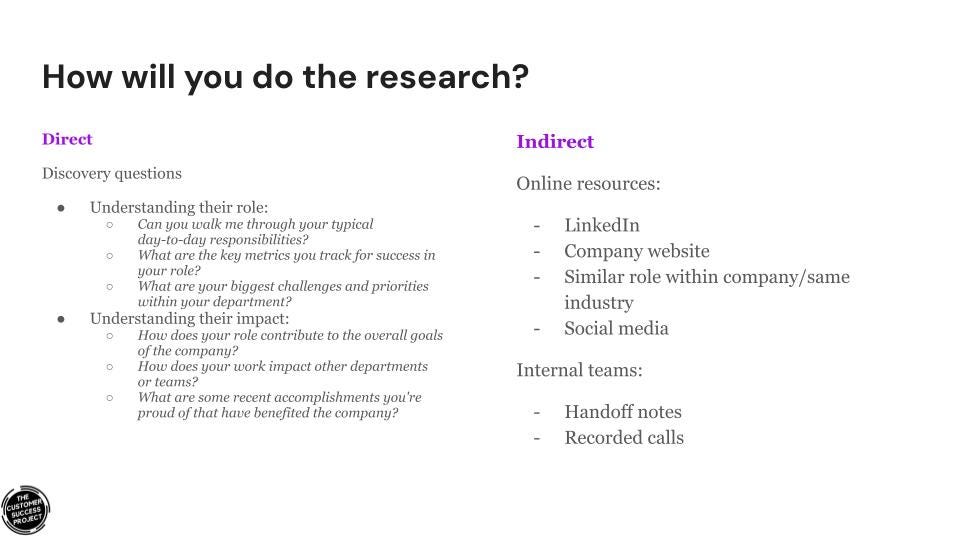
Speaking of information, let’s go to our next pillar – Insights!
Insights Pillar & QBRs
The Insights pillar is all about data—the data you have, the data you need, and how you’ll interpret that data.
I like to separate insights into two categories: direct and indirect insights.
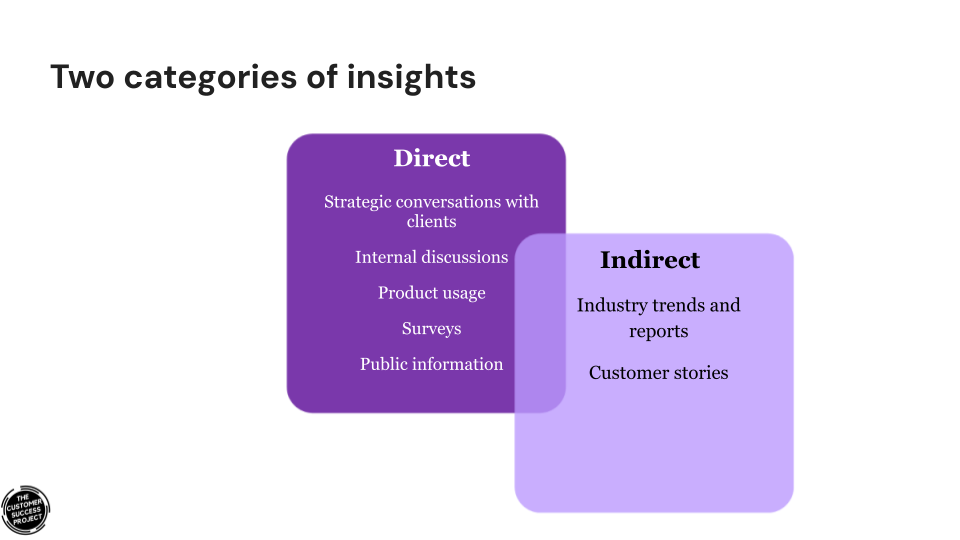
Direct insights are about the client. These are their adoption metrics, survey results, previous conversations, and even information you’ve found on the internet about them.
Indirect insights, on the other hand, are in the client's sphere but not directly about them. These could be about their industry or even stories about customers who look/sound like them.
With all of these data points, your next step is to comb through and make sense of the information.
I’m a huge advocate of AI to help CSMs save time, so don’t be afraid to use it as your sounding board when you’re building narratives.
But, proceed with caution here: Just because we’re digging through what feels like a ton of information, not every data point needs to be shared on a QBR.
All of this data is meant to get you up to speed on what’s happening with the account but also, what’s happening to the client outside of your tool. It would suck to show up to a QBR all happy and ready to go when they’ve just done a massive round of layoffs, and it was public information.

With your insights at hand, it’s time to think about a game plan.
Strategy Pillar & QBRs
The strategy pillar is about what you’ll do!
Now that you know who will be present and have data in your corner, you can consider your strategy for the QBR.
Remember earlier when I shared following a template to a tee? Yeah, we want to avoid that. This is where you think about the objective(s) for your QBR, given what you know and the actions you’d like to invoke.
To develop your strategy, you can ask yourself a few questions first:
“What’s my desired outcome of the QBR?”
“What should be the client's biggest takeaway from this QBR?”
Then, I want you to drop into specifics:
“Are there any risks/concerns I need to address?”
“What do I absolutely need to bring up on this QBR?”
“Am I missing information that the client can provide me with?”
This is where you outline:
How your data will tell a story
Your plan to address the challenges/issues/objections
The questions you’ll need to ask them
Your plan to engage your audience throughout
Additional points that need to be raised (i.e., upsell/renewal/pilot program)
Clear action items/next steps to keep the momentum going
How you’ll engage with your stakeholders before and after the QBR
But we all know planning is one thing and doing is a whole ‘nother story, so let’s get into action with our next pillar.
Execution Pillar & QBRs
Lastly, execution is all about HOW you’ll do it!
This is where you’ll implement your plan for your QBR, but we’re not just talking about your slides here. You’ll want to account for the pre-, during-, and post-QBR activities if you want to make them… strategic.
Pre QBR
Will you collaborate with your POC on the deck?
Does your invitation read in a way that highlights the value of the event for the stakeholders?
Are you sending the agenda ahead of time?
During QBR
What’s the structure of your QBR presentation?
How is my messaging focused on “what’s in it for them?” instead of “what’s in it for me?”
What direct questions are you asking, and do you have questions for specific stakeholders? When is the right time to ask these questions?
Are you using a deck? If so, what structure are you following for your QBR deck?
How will you encourage feedback during the call?
Do you have a TL;DR slide that sums up the call and includes the biggest takeaways?
What are the clear next steps stemming from the QBR?
Post QBR
What was your sentiment on that QBR? Any areas of wins/improvements? (Keep track of this! It’s how you’ll improve your QBRs over time)
What follow-up items came out of the call, and what’s your plan for actioning them?
What are you sharing in your follow-up email?
What’s your plan for measuring any progress from any discussions/recommendations made on the call?
QBRs can absolutely deliver a ton of value… If we stop making them so generic.
But to get there, we need to clarify their purpose and the skills we need to continue sharpening to make them more effective. The RISE System helps us take a step back and truly understand how we can be more strategic in our approach to QBRs.
This post is just the beginning...
If you're ready to run QBRs that are impactful and your clients actually look forward to, we've got you covered in this course (which comes with its very own value-rich QBR deck, so you don't have to start from scratch).
Newsletter
Weekly Newsletter With Actionable Insights
Gain the skills, knowledge, and confidence to succeed in Customer Success & Account Management: 0% theories, 100% actionable insights.