- Sep 13, 2024
Client Stakeholders In Customer Success | Who Are They and What Do They Want?
- Diana De Jesus
“Why are we working on this? Who said this was our priority?”
Those were the questions I was met with on an Executive Business Review (EBR) with one of my biggest accounts.
My one wish at that very moment was to trade places with Homer when he disappears into the bush.

“This is something [point of contact 1] and [point of contact 2] and I have been working on for the last few months. Your team wanted to work on rolling this out so you can be more efficient.” I replied.
“Efficiency? Yeeeah… but that’s not the priority!” said the VP again.
At that moment, I learned a very valuable lesson that I find many CSMs learn the hard way:
Your client stakeholders may all work at the same company, but that doesn’t mean they’re all on the same page.
I was blindly chipping away at our action plan with the end users without engaging the key stakeholders – the decision-makers. I just assumed the end-users would do that, silly me 🙃
Basically… I wasn’t managing my stakeholders.
“Stakeholder management” is a beast, so we’re gonna tackle this in parts.
In this post, we’re diving into three stakeholder profiles (that’s all we need). We’ll look at who they are, what they want (and don’t), and what they really want to hear from us. Let’s #upskill!
#UpSkill | Stakeholder profiles
You might’ve heard of different categories for stakeholders like “executive sponsors,” “decision-makers,” “champions,” etc. It’s not wrong, but to keep it simple, we’re going to place our core stakeholders in three buckets:
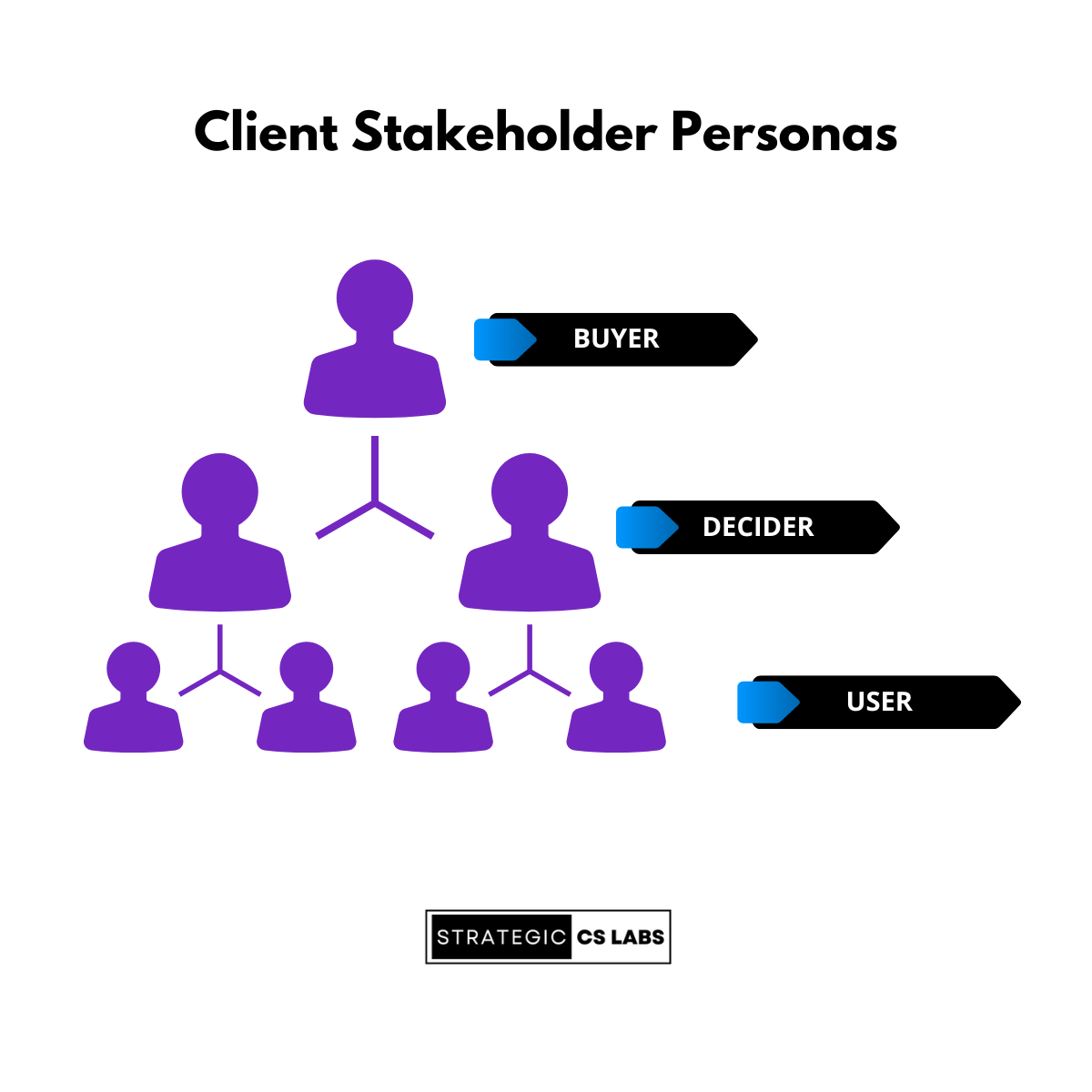
Let’s take a look at each one:
Buyer
Who are they? This is the individual or group responsible for the financial transaction of purchasing the product. They have the authority to find the budget and make final purchasing decisions.
What are they interested in? Buyers are primarily focused on the cost-effectiveness and ROI of the product. They want to know about pricing, potential savings, and the financial benefits of adopting the solution. (They care about MONEY!)
What they don’t like? They are not interested in the technical specifics of how the product works or detailed user functionalities that don't directly relate to cost or ROI.
What’s music to their ears? Showing value/ROI and aligning product benefits to their overall financial goals and strategy. You're winning if you can give them a data point that helps them tell a story in their next board meeting!
Decider
Who are they? Deciders are executive sponsors and influential stakeholders within the client's organization who may not directly make the purchase but have significant influence over the buying decision. They can include department heads, senior executives, or any key influencer within the organization.
What are they interested in? Deciders, such as executive sponsors and influential stakeholders, are interested in strategic advantages, competitive differentiation, and long-term benefits of the product. They look for how the solution aligns with their broader business goals.
What they don’t like? They typically don't want to be bogged down with operational details, granular user feedback, or features that don’t directly impact strategic outcomes.
What’s music to their ears? They also care about value/ROI! They want to see how the product/service capabilities align with their organization’s strategic objectives. They want you to show them how your product is “moving the needle” and highlight the long-term benefits of continuing with your product/service.
User
Who are they? Users are the individuals who will directly interact with the product on a day-to-day basis. This group includes those implementing the product and end-users adopting it as part of their workflow.
What are they interested in? Users are interested in the product's usability, functionality, and support aspects. They care about how the product will make their daily tasks easier and more efficient and how well it integrates into their existing workflows.
What they don’t like? Users are usually not interested in the pricing structure, contractual details, or strategic business benefits that don't affect their direct interaction with the product.
What’s music to their ears? Enablement! They want training, support, and resources to confidently adopt the product and be satisfied using it. Feedback loops play a big role here to get insights on user experience – hear them out and implement improvements.
Can it be measured?
Mmhmm.
But “What are we measuring?” is the question. In this case, we want a checklist:
Have we correctly identified the different stakeholders?
How are we engaging with them?
When are we engaging with them?
Are we tracking our relationship sentiment with each stakeholder?
Sometimes, measuring starts with getting your ducks in a row!
Newsletter
Weekly Newsletter With Actionable Insights
Gain the skills, knowledge, and confidence to succeed in Customer Success & Account Management: 0% theories, 100% actionable insights.