- Aug 30, 2024
How To Apply Value Engineering Strategies To Client Management To Drive More Value
- Diana
I want to make a case for why we, the Customer Success field, should add Value Engineering to our smorgasbord of fields we draw inspiration from.
It’s not that different from what we do in Customer Success, but what they do better than we do is that their role is all about value and ROI–things we sometimes struggle to compute or communicate effectively in Customer Success.
So, if you or your team has been struggling with the ROI boogyman, this mini crash course on value engineering (with actionable steps, of course) is for you. Let’s dive in!
Injecting Value Engineering Into Customer Success
Let’s start with the basics…
What is Value Engineering?
In the context of SaaS (Software as a Service), value engineers act as pre-and post-sales consultants. They dive deep into a client's business to understand their goals, challenges, and current processes (sounds familiar, right?).
Using financial modeling and data analysis, they calculate the projected increase in revenue, cost savings, and overall performance the client can expect by using the SaaS product (okay, here’s the difference). This translates into a compelling "Business Case" or "Business Value Assessment" presented to key decision-makers to justify the investment.
Similarities and differences in both professions
It’s not that different from what we do in Customer Success, but what they do better than we do is that their role is all about value and ROI–things we sometimes struggle to compute or communicate effectively in Customer Success. Let’s double down on Customer Success Managers (CSMs), for example.
Both CSMs and value engineers share a customer-centric focus. They aim to:
Understand client needs: Through deep discovery and active listening, both roles uncover the client's specific challenges and opportunities.
Quantify value: Value engineers translate the impact of their solution into financial terms, while CSMs demonstrate the value of the SaaS product through metrics and success stories.
Build strong relationships: Both roles foster long-term client relationships through clear communication and ongoing support.
And here’s where they differ:
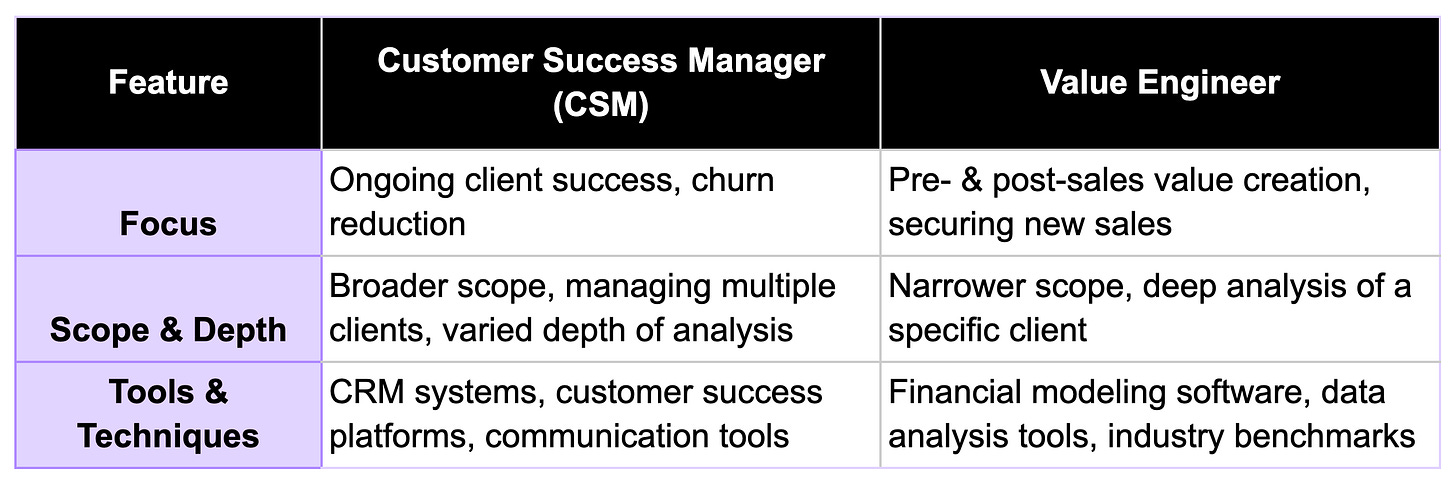
3 Ways CSMs can implement Value Engineering practices (with examples & actionable tips, of course)
By incorporating value engineering techniques, CSMs can transform into "mini value engineers" for their clients. Here's a deeper dive into three ways to implement these practices in your daily work.
1. Conduct Value Discovery Sessions:
Inspiration: Value engineers conduct in-depth discovery to understand a client's business. CSMs can mirror this by going beyond standard onboarding.
-
Action: Schedule dedicated "Value Discovery Sessions" early in the client relationship. Here's how to make them impactful:
Preparation is Key: Prior to the session, review the client's industry trends, customer base, and any existing usage data.
Active Listening: Ask open-ended questions that go beyond basic functionality. For example, instead of "Are you using the reporting feature?", ask "How are you currently measuring campaign success, and how could our reporting tools help you improve that?"
Focus on Outcomes, Not Features: Uncover the client's business goals and challenges. How is their current process inefficient? What are they hoping to achieve?
Example: During a Value Discovery Session with a marketing automation client, the CSM learns the client struggles with high lead nurturing drop-off rates. Digging deeper, the CSM discovers the client lacks a system for segmenting leads and delivering targeted content. This could indicate a need for the client to utilize the platform's lead segmentation and email marketing automation features.
2. Develop Customer-Specific Business Cases:
Inspiration: Value engineers create financial models to quantify the impact of their solutions. CSMs can adapt this by crafting "Customer-Specific Business Cases."
-
Action: Here's how to build compelling business cases:
Identify the Right Metrics: Focus on metrics that align with the client's business goals identified during the Value Discovery Session. This could be increased qualified leads, improved customer satisfaction scores, or cost savings.
Leverage Data & Industry Benchmarks: Use historical client data and industry benchmarks to show the potential impact of using specific features.
Focus on ROI: Quantify the projected benefits in a way that resonates with the client. For example, show how a 20% increase in qualified leads translates to a projected increase in sales revenue. Here, you’re making numbers come to life!
Example: Building upon the lead nurturing example, the CSM can present a business case showing how targeted email campaigns (a higher service tier feature) can lead to a 20% increase in qualified leads. The CSM can support this claim by showcasing historical data from similar clients and industry benchmarks for lead conversion rates. They can then calculate the projected increase in sales based on the client's average deal size and conversion rate.
3. Leverage Data and Analytics for Storytelling:
Inspiration: Value engineers use data and financial modeling to create compelling presentations.
-
Action: CSMs can leverage customer usage data and analytics to tell compelling stories about the value their clients are getting:
Tailor Your Story: Don't overwhelm clients with technical jargon. Focus on translating data points into clear, concise narratives that demonstrate progress towards their goals.
Visualize Your Data: Use charts, graphs, and other visuals to make data easily digestible and impactful.
Highlight Success Stories: Showcase examples of how other clients in similar industries have achieved success using the same features.
Example: The CSM can present a report showing how the client's engagement with the marketing automation platform has led to a 15% reduction in customer churn rate. Instead of just presenting the data point, the CSM can explain how this translates to a significant cost savings for the client based on their customer lifetime value (CLTV). They can also showcase stories of other clients who have used the platform to improve customer retention.
🔥 Bonus Tips:
Tailor Your Approach: Not all clients require a formal business case, intensive discovery, or high touch. Adapt your communication style and level of detail based on the specific client and their needs.
Become a Data Champion: CSMs often ask me what skills they should learn or certifications they should complete. You’ll always hear “data” in my answer. Develop your data analysis skills and stay informed on industry benchmarks to leverage data effectively in your communication.
By incorporating these value engineering techniques, CSMs can become the elusive trusted advisors who demonstrate true value!
Can it be measured?
A subjective measurement of this “skill” would be an increased ability to quantify and communicate value.
By integrating value engineering into your CS role, the hope is that you become sharper with your client discovery questions (they are more direct and more metrics-deriving). These insights should lead you to numbers you can use to calculate value as it relates to the client and in a way that resonates with your client. Lastly, help tap into your data analytics/data storytelling skills (because it’s at the base of the role of a value engineer).
Newsletter
Weekly Newsletter With Actionable Insights
Gain the skills, knowledge, and confidence to succeed in Customer Success & Account Management: 0% theories, 100% actionable insights.